


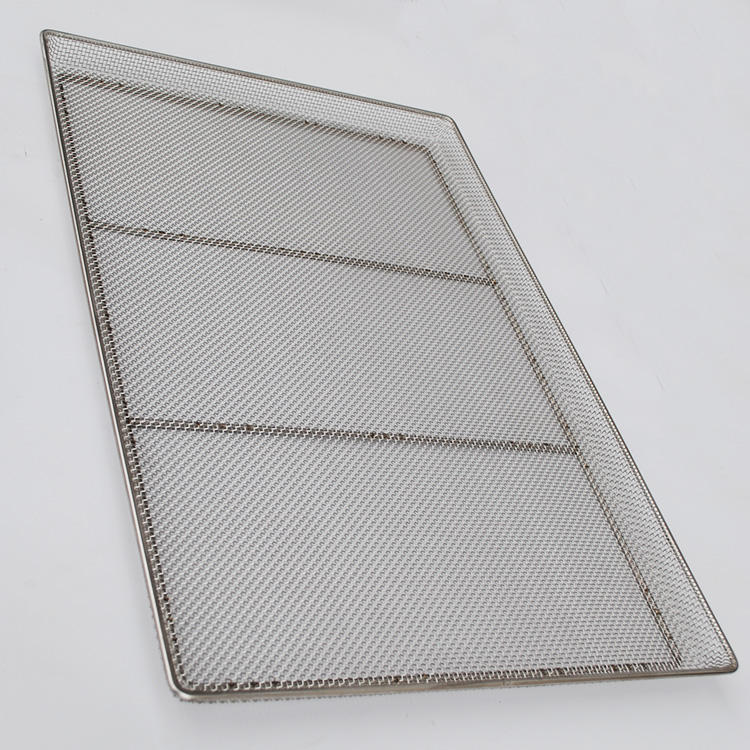
Wire Mesh Dehydrator Tray: A Strategic Sourcing Guide for Industrial Buyers
Product Introduction
For industrial buyers, a wire mesh dehydrator tray is not merely a perforated metal sheet; it is a precision-engineered component designed for continuous production environments where hygiene, load stability, and long-term operational reliability are non-negotiable. These trays are the backbone of drying, cooling, baking, and sterilization processes across food processing, pharmaceutical, and heavy manufacturing sectors. The core function is to facilitate optimal airflow while securely supporting products through repeated handling and high-temperature cycles. Without a properly specified tray, manufacturers face risks ranging from compromised product integrity due to uneven drying to costly downtime from tray failure. As a manufacturer, we understand that sourcing the correct wire mesh dehydrator tray is a strategic decision that balances upfront cost with total cost of ownership, impacting everything from energy efficiency to final product quality.
Product Features and Engineering Advantages
The performance of a wire mesh dehydrator tray hinges on its structural integrity and manufacturing precision. Our trays are engineered with a focus on durability and process efficiency, addressing common pain points like deformation under load and inadequate airflow.
- Reinforced frame design: The load-bearing frame is constructed from heavier-gauge wire or formed steel channels, significantly improving load stability during repeated transportation and high-frequency industrial handling. This prevents sagging and ensures consistent performance across multiple production cycles.
- Precision mesh welding: Each wire intersection is securely welded using automated resistance welding, creating a rigid mesh structure that maintains its shape and mesh opening under thermal expansion and mechanical stress. This is crucial for applications requiring uniform airflow and product support.
- Optimized open area: The mesh pattern is selected to maximize open area for efficient air and fluid passage while providing sufficient support for the product. This engineering balance is key to reducing drying times and energy consumption.
- Easy-to-clean surface: The smooth, polished welds and the use of high-quality stainless steel ensure that the tray can be effectively cleaned and sanitized between batches, meeting stringent hygiene standards in food and pharmaceutical production.
- Custom manufacturing options: From custom dimensions to specialized edge treatments (e.g., upturned edges, reinforced corners), we adapt the tray design to fit specific equipment and process requirements, ensuring seamless integration into existing production lines.
These features translate into tangible advantages: reduced product loss, lower maintenance costs, and enhanced operational safety. For instance, the reinforced frame means fewer trays need replacement due to bending, while the optimized mesh design can lead to faster drying cycles and energy savings.
Application Scenarios
The versatility of the wire mesh dehydrator tray makes it indispensable across a wide range of industries. Each application demands specific tray characteristics, and understanding these nuances is essential for procurement.
- Food Processing and Dehydration: Used for drying fruits, vegetables, meats, and seafood. The tray must be made of food-grade stainless steel (304 or 316) to prevent contamination and withstand frequent washdowns. The mesh design ensures even airflow, preventing case hardening and ensuring consistent moisture removal.
- Bakery and Confectionery: For baking bread, pastries, and cookies, trays are often used in rack ovens. The wire mesh allows heat to circulate uniformly, resulting in even baking and reduced energy consumption. Trays must withstand high temperatures without warping.
- Pharmaceutical and Laboratory: In sterile environments, trays are used for drying granules, tablets, and laboratory glassware. 316 stainless steel is often required for its superior corrosion resistance and cleanability. Trays must be designed for easy sterilization.
- Industrial Manufacturing and Cleaning: Used for parts washing, degreasing, and drying. The tray must resist chemical attack and support heavy loads. Robust construction and corrosion-resistant materials are paramount.
- Storage and Transportation: As a commercial drying rack component, the tray facilitates organized storage and transport of goods between production stages. Stackability and load stability are key considerations.
In each scenario, the wire mesh dehydrator tray is selected not just for its basic function but for its ability to enhance process efficiency, ensure product quality, and reduce operational costs over its service life.
Material Options and Manufacturing Details
Material selection is a critical decision that impacts cost, performance, and compliance. We offer a range of materials to suit different environments and budgets.
- 304 Stainless Steel: The industry standard for food contact applications. It provides reliable corrosion resistance for daily industrial cleaning environments and is suitable for most food processing and bakery applications. It offers a good balance between cost and performance.
- 316 Stainless Steel: Offers superior corrosion resistance, particularly against chlorides and harsh chemicals. It is the material of choice for pharmaceutical, chemical, and marine applications, as well as food processing where aggressive cleaning agents are used. The higher molybdenum content ensures longevity in demanding environments.
- 201 Stainless Steel: A lower-cost alternative with adequate corrosion resistance for dry environments and light-duty applications. It is not recommended for frequent wet cleaning or exposure to corrosive substances. Often used in storage and general manufacturing.
- Aluminum: Lightweight and corrosion-resistant (with proper treatment), aluminum trays are suitable for baking and cooling where weight reduction is important. However, they are less durable than stainless steel and may not withstand harsh cleaning chemicals.
Our manufacturing process includes precise wire drawing, mesh weaving or welding, frame forming, and surface treatment (passivation or pickling) to ensure optimal corrosion resistance. Each tray is inspected for dimensional accuracy, weld integrity, and surface finish before shipment.
Specifications and Technical Parameters
To ensure a perfect fit and optimal performance, buyers should specify the following parameters. We can customize each aspect to meet your exact requirements.
- Dimensions: Length x Width x Height (including edge configuration). Trays can be designed to fit existing rack systems, ovens, or conveyors.
- Mesh Opening: The distance between parallel wires, typically ranging from 2mm to 25mm, determined by product size and airflow requirements.
- Wire Diameter: The thickness of the mesh wire, usually 0.8mm to 3.0mm, influencing load capacity and durability.
- Frame Thickness: The gauge of the frame material, often 1.0mm to 2.0mm, affecting overall rigidity.
- Load Capacity: The maximum distributed load the tray can support without permanent deformation, typically 20kg to 150kg depending on design.
- Surface Treatment: Passivation, pickling, or polishing to enhance corrosion resistance and cleanability.
- Production Tolerance: Dimensional tolerances within ±1mm for critical dimensions to ensure compatibility.
- Tray Compatibility: Trays can be designed with features like stacking lugs, reinforced edges, or custom handles for easy integration.
For custom requirements, please contact our team to discuss your specific application and equipment dimensions.
Custom OEM Manufacturing Service
As an experienced OEM stainless steel tray manufacturer, we provide comprehensive customization services to meet the unique needs of our B2B clients. Our engineering team collaborates with you to develop trays that optimize your production process.
- Custom Size and Design: From unique dimensions to specialized edge profiles, we manufacture trays that fit your equipment precisely.
- Material Selection: We advise on the most cost-effective material grade based on your operating environment and cleaning protocols.
- Logo Marking: We can emboss or engrave your company logo for branding and inventory management.
- Special Packaging: We offer export-grade packaging, including wooden crates and moisture barrier bags, to ensure safe delivery.
- Prototype Development: We can produce prototypes for testing and validation before bulk production.
- Bulk Production: With automated production lines, we ensure consistent quality and on-time delivery for large orders.
For custom requirements, please contact our team to discuss your project. We are committed to providing tailored solutions that enhance your operational efficiency.
Purchasing Guide for Industrial Buyers
Making an informed purchase requires careful consideration of several factors. This guide helps procurement professionals navigate the decision-making process.
How to Choose the Right Size?
Start by measuring your existing equipment (racks, ovens, conveyors) and determine the maximum dimensions that fit. Consider the product size and loading pattern to optimize tray utilization. Allow clearance for airflow and handling. If you are designing a new system, consult with our engineers for recommendations.
How to Select the Material?
Assess the operating environment: temperature, humidity, exposure to chemicals, and cleaning methods. For food contact, 304 stainless steel is the minimum; for harsh chemicals or high-chloride environments, choose 316. For dry environments, 201 may suffice. Consider the total cost of ownership—a higher initial cost for 316 may be offset by longer life and reduced replacement costs.
How to Confirm Specifications?
Request a detailed drawing or specification sheet from the supplier, including mesh opening, wire diameter, frame dimensions, and tolerances. Ensure these align with your process requirements. If unsure, request a sample for testing.
How to Judge Supplier Capability?
Evaluate their production capacity, quality control processes, and export experience. Ask for certifications (ISO 9001, food safety certifications) and customer references. A factory audit or video tour can provide insights into their manufacturing standards.
What to Consider for Bulk Purchasing?
Negotiate lead times and delivery schedules. Confirm packaging details to prevent damage during transit. Establish a quality acceptance criteria and inspection protocol. Consider a trial order before committing to a large volume. Ensure the supplier has a reliable track record for on-time delivery.
Key purchasing considerations checklist:
- Confirm working environment (temperature, humidity, chemicals)
- Check material requirements (food grade, corrosion resistance)
- Verify equipment compatibility (dimensions, loading method)
- Evaluate supplier production capacity and quality control
- Clarify packaging and delivery terms
- Request samples and certifications
FAQ
Q1: What stainless steel grade is recommended for food processing applications?For most food processing, 304 stainless steel is the standard due to its excellent corrosion resistance and food safety compliance. However, if your process involves high-chloride environments, acidic foods, or aggressive sanitizers, 316 stainless steel is recommended for superior durability and to prevent contamination. Our team can help you select the optimal grade based on your specific products and cleaning procedures.
Q2: Can the tray size be customized?Yes, we specialize in custom manufacturing. We can produce trays in any size to fit your equipment, from small laboratory trays to large industrial rack trays. Simply provide your required dimensions and any design constraints, and our engineers will design a tray that meets your needs. Custom sizes typically have a minimum order quantity, which we can discuss based on your requirements.
Q3: Do you provide OEM manufacturing service?Absolutely. We offer full OEM services, including custom design, logo marking, special packaging, and private labeling. Our engineering team can work with your drawings or develop a new design from scratch. We maintain strict confidentiality and can sign NDAs as required. For OEM inquiries, please contact our sales team with your specifications.
Q4: What information should buyers provide before quotation?To provide an accurate quotation, we need: tray dimensions (length, width, height), material preference (304, 316, etc.), mesh specifications (opening, wire diameter), load requirements, surface treatment, quantity, and any special features (e.g., stacking lugs, handles). If you have drawings or samples, please share them. This information helps us recommend the most cost-effective solution.
Q5: How do you control product quality?We implement a comprehensive quality control system from raw material inspection to final shipment. Each production batch undergoes dimensional checks, weld strength testing, and surface finish inspection. We also perform load tests on samples to ensure structural integrity. Our facility is ISO 9001 certified, and we can provide material certificates and inspection reports with each order. Third-party inspections are welcome.
Q6: What is the typical lead time for bulk orders?Lead time depends on order quantity and customization complexity. For standard trays, production typically takes 15-25 days after order confirmation. Custom designs may require 25-35 days, including sample approval. We will provide a detailed schedule upon order placement and keep you updated on progress. Expedited services are available for urgent requirements.
Q7: Do you offer samples for testing?Yes, we can provide samples for evaluation. For standard designs, a nominal sample fee applies, which is refundable upon bulk order. For custom designs, a prototype development fee may be charged. Sample lead time is usually 7-10 days. We encourage testing to ensure the tray meets your performance expectations before committing to volume production.
Q8: What are your payment terms?We accept flexible payment terms for our B2B clients. Typically, we require a 30% deposit upon order confirmation, with the balance due before shipment. For established customers, we can discuss alternative terms. We accept T/T, L/C, and other common methods. Please contact us to discuss terms that suit your purchasing process.

