


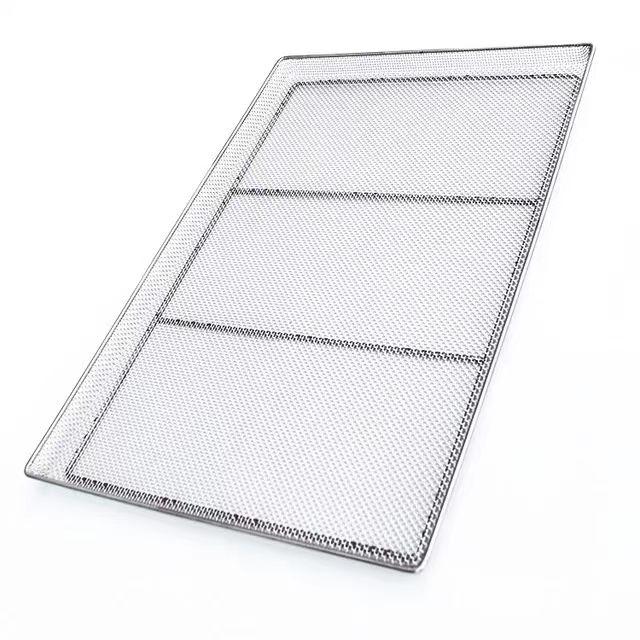
Stainless Steel Baking Tray Sourcing Guide for Industrial Food Processing
Product Introduction
In industrial food processing environments, the stainless steel baking tray is not a consumer kitchen accessory but a critical production component. It is the physical interface between raw product and processing equipment—whether that means a continuous baking line, a blast chiller, a drying tunnel, or a logistics system moving semi-finished goods between departments. When a tray fails, production stops. When a tray contaminates product, the entire batch is rejected. These are the realities that drive procurement decisions in this category.
From a manufacturer's perspective, industrial baking trays are engineered to solve specific production problems: maintaining hygiene under repeated washdown cycles, providing dimensional stability at temperature extremes, and surviving thousands of handling cycles without deformation. The stainless steel baking tray is typically specified by food processing plants, commercial bakeries, pharmaceutical manufacturers, and industrial drying operations that require reliable load-bearing performance and corrosion resistance in continuous production settings.
Why do industrial buyers need this product? Because standard commercial trays are not designed for the duty cycles of industrial production. A bakery producing 20,000 units per shift cannot afford tray failure at hour six. A food processing plant running caustic washdowns between batches needs tray surfaces that resist pitting and crevice corrosion. The procurement decision is therefore not about finding the lowest price per unit—it is about total cost of ownership across the tray's service life.
Product Features and Engineering Advantages
Industrial stainless steel baking trays differ from consumer-grade products in ways that matter to procurement teams. The engineering advantages are deliberate and measurable.
Structural design: The reinforced frame and corner construction improve load stability during repeated transportation and high-frequency industrial handling. Trays are often subjected to automated stackers, conveyor transitions, and manual loading where impact forces concentrate at the corners. A properly engineered tray distributes these forces across the frame rather than transferring them to the base panel, which reduces permanent deformation over time.
Manufacturing process: Trays are produced using precision stamping, robotic welding, and controlled surface finishing. Welds are typically ground and polished to eliminate crevices where bacteria and moisture can accumulate. This is particularly important for food contact applications where hygiene standards require smooth, continuous surfaces without harborage points.
Performance advantages: The combination of material grade, gauge thickness, and structural design delivers a tray that maintains flatness under thermal cycling—a common failure mode in baking applications where trays move between high-temperature ovens and cooler ambient environments. Flatness matters because warped trays cause product sticking, uneven baking, and jamming in automated handling systems.
Industrial environment adaptability: Trays are designed for chemical exposure from cleaning agents, thermal stress from process temperatures, and mechanical stress from handling equipment. The material selection and surface treatment are matched to the specific operating environment, which is why custom stainless steel tray specifications are common in this market.
Key product features include:
- High corrosion resistance for food contact and washdown environments
- Easy cleaning surface with smooth welds and crevice-free construction
- Stable load capacity under repeated industrial handling
- Custom manufacturing options for equipment-specific dimensions
- Thermal stability across baking, cooling, and drying temperature ranges
- Stackability and compatibility with automated handling systems
Application Scenarios
The application range for industrial stainless steel baking trays extends well beyond baking. Understanding the specific demands of each scenario is essential for correct specification.
Food processing: Trays are used for transporting, cooling, freezing, and holding product between processing stages. The tray must withstand frequent washdowns with caustic or acidic cleaning agents while maintaining a hygienic surface. Stainless steel is specified because it does not harbor bacteria, does not react with food acids, and can be cleaned to a microbiological standard.
Bakery production: In commercial bakeries, trays move through proofers, ovens, and cooling tunnels. Thermal cycling is the primary stress factor. Trays must maintain flatness and dimensional stability across temperature differentials that can exceed 250°C. The tray surface must also release product cleanly without sticking or requiring excessive release agents.
Industrial manufacturing: Beyond food, trays are used to hold components during cleaning, coating, drying, and assembly processes. In these applications, the tray is often a custom-designed fixture that integrates with automation equipment. Load capacity calculation and dimensional tolerance are critical.
Drying processes: A stainless steel drying tray is used in food dehydration, chemical drying, and pharmaceutical drying applications. Mesh or perforated designs are common to allow airflow through the product bed. The tray must resist corrosion from moisture and process chemicals while maintaining structural integrity under load.
Cleaning processes: Trays are used to hold parts or product during ultrasonic cleaning, spray washing, and immersion cleaning. The tray material must be compatible with the cleaning chemistry and must not contribute contaminants to the cleaning bath.
Storage and transportation: Trays serve as standardized containers for work-in-progress inventory. Stackability, dimensional consistency, and load rating are the primary considerations. In automated storage systems, tray dimensional tolerance must be tight enough to ensure reliable robot or conveyor handling.
Pharmaceutical and laboratory: In these environments, trays are used for drying, sterilizing, and storing materials. Surface finish and material traceability are critical. Trays are often specified as 316 stainless steel to provide enhanced corrosion resistance against aggressive chemical exposure.
Commercial production: Large-scale catering operations, central kitchens, and food assembly facilities use trays for batch production, blast chilling, and distribution. The tray must survive the full production cycle from cooking through chilling and rethermalization.
Material Options and Manufacturing Details
Material selection is the most consequential specification decision in stainless steel baking tray procurement. The grade determines corrosion resistance, cost, and suitability for the operating environment.
304 stainless steel: The standard grade for food contact applications. 304 provides reliable corrosion resistance for daily industrial cleaning environments and is suitable for most bakery, food processing, and general manufacturing applications. It offers a good balance of performance and cost, and is widely available in the supply chain.
316 stainless steel: The specification for aggressive environments. 316 contains molybdenum, which significantly improves resistance to chloride pitting and crevice corrosion. It is recommended for pharmaceutical applications, chemical processing, and food processing environments where high-chloride cleaning agents or salt exposure are present. The cost premium over 304 is typically 30-50%, which is justified only when the operating environment demands it.
201 stainless steel: A lower-cost alternative with reduced nickel content. 201 offers adequate corrosion resistance for dry or low-moisture applications but is not recommended for frequent washdown or chemical exposure. It is sometimes specified for storage and transportation trays where the environment is controlled and the primary requirement is structural strength rather than corrosion resistance.
Aluminum: While not stainless steel, aluminum trays are used in some baking applications where weight reduction is a priority. Aluminum offers excellent thermal conductivity but lower corrosion resistance and mechanical strength than stainless steel. It is not suitable for caustic washdown or high-impact handling environments.
Manufacturing details that affect tray performance include weld quality, surface finish (2B, BA, or polished), and dimensional tolerance. Welds should be continuous and ground smooth on food contact surfaces. Surface finish affects cleanability and product release. Dimensional tolerance affects compatibility with automated handling equipment and stackability.
Specifications and Technical Parameters
Procurement teams should confirm the following parameters before finalizing a purchase order. Where specific values are not listed, industry-typical ranges apply and can be customized.
- Size: Available sizes can be customized according to equipment dimensions and production requirements. Standard footprints range from 400×600 mm to 800×1200 mm, with custom dimensions available for specific oven or conveyor systems.
- Thickness: Material gauge typically ranges from 0.8 mm to 2.0 mm depending on load requirements and handling conditions.
- Load capacity: Static load ratings typically range from 15 kg to 50 kg per tray, depending on size and gauge. Dynamic load ratings for automated handling are lower and should be confirmed with the manufacturer.
- Layers: For rack-compatible trays, layer spacing and rack compatibility should be confirmed against the existing equipment.
- Mesh opening and wire diameter: For mesh trays, common mesh openings range from 5×5 mm to 25×25 mm, with wire diameters from 1.0 mm to 3.0 mm. The mesh specification should balance airflow, product support, and structural strength.
- Surface treatment: Standard finishes include 2B mill finish, BA bright annealed, and polished. Electrochemical passivation is available for pharmaceutical and high-hygiene applications.
- Production tolerance: Dimensional tolerance is typically ±1 mm for standard trays and ±0.5 mm for precision applications. Flatness tolerance is typically 1-2 mm per meter.
Custom OEM Manufacturing Service
For industrial buyers sourcing trays for specific equipment or production lines, standard catalog products rarely fit. Custom manufacturing capability is a core supplier evaluation criterion.
OEM stainless steel tray manufacturing services typically include:
- Custom size and geometry based on equipment drawings or site measurements
- Custom design including reinforcement, stacking features, and handling interfaces
- Logo marking and product identification for traceability
- Special packaging for export shipment and warehouse storage
- Material selection consulting based on the operating environment
- Prototype development for fit and function verification before bulk production
- Bulk production with consistent quality control and documented inspection
For custom requirements, please contact our team. Provide equipment dimensions, operating environment details, load requirements, and any existing tray samples or drawings. A technical review and quotation can typically be completed within 5-7 working days.
Purchasing Guide for Industrial Buyers
This section addresses the practical questions that B2B buyers face when sourcing stainless steel baking trays.
How to select the right size? Start with equipment compatibility. Measure the oven, conveyor, rack, or storage system that the tray will interface with. Confirm clearances for handling equipment. If replacing existing trays, provide a sample or detailed drawing. Do not assume that nominal dimensions are interchangeable between suppliers—tolerance and corner radius vary.
How to choose the material? Match the grade to the operating environment. 304 is suitable for most food contact and washdown applications. 316 is recommended for chloride exposure, pharmaceutical, or aggressive chemical environments. 201 is acceptable for dry storage and transportation. When in doubt, specify 304 as the baseline and upgrade only when the environment requires it.
How to confirm specifications? Request a technical datasheet and a sample for physical verification. Confirm material grade with mill certificates. Verify dimensional tolerance and flatness. Test stackability and handling compatibility with your equipment.
How to evaluate supplier capability? Request evidence of quality control processes, production capacity, and export experience. Ask for references from similar industrial customers. Review packaging standards for export shipment. Confirm delivery lead times and production scheduling capability.
What to check in bulk procurement? Confirm the inspection protocol, sampling plan, and documentation package. Verify that packaging protects trays from deformation during transit. Confirm the delivery schedule and Incoterms. Establish a clear specification sheet that both parties sign off before production begins.
Procurement checklist:
- Confirm the working environment including temperature, chemicals, and handling method
- Check material requirements against the operating environment
- Verify equipment compatibility including dimensions, clearances, and handling interfaces
- Evaluate supplier production capacity, quality control, and export experience
- Confirm packaging, delivery schedule, and documentation requirements
FAQ
What stainless steel grade is recommended for food processing applications?
304 stainless steel is the standard recommendation for most food processing applications. It provides reliable corrosion resistance for food contact and daily cleaning environments. For applications involving high-chloride cleaning agents, salt exposure, or pharmaceutical-grade hygiene requirements, 316 stainless steel is recommended. The material grade should always be confirmed against the specific operating environment.
Can the tray size be customized?
Yes. Custom sizes are a standard offering for industrial orders. Provide the equipment dimensions, required clearances, and load requirements. Custom trays can be manufactured to fit specific ovens, conveyors, racks, and storage systems. A technical drawing is typically required for confirmation before production.
Do you provide OEM manufacturing service?
Yes. OEM manufacturing services include custom size, custom design, logo marking, special packaging, material selection, prototype development, and bulk production. For custom requirements, contact our team with your specifications and application details. Prototypes can be developed for fit and function verification before committing to bulk production.
What information should buyers provide before quotation?
Buyers should provide tray dimensions, material grade preference, load requirements, operating environment details, surface finish requirements, quantity, and delivery destination. If replacing existing trays, a sample or drawing is helpful. The more detail provided, the more accurate the quotation and the lower the risk of specification mismatch.
How do you control product quality?
Quality control includes incoming material inspection with mill certificates, in-process inspection of dimensions and weld quality, final inspection of flatness and surface finish, and packaging inspection before shipment. Inspection records and material certificates are available with shipment. For critical applications, third-party inspection can be arranged.
What is the typical lead time for bulk orders?
Lead time depends on order quantity, customization requirements, and production scheduling. Standard products typically ship within 15-25 working days after order confirmation. Custom products may require 25-35 working days including prototype approval. Lead times should be confirmed at the quotation stage and documented in the purchase order.
How should trays be packaged for export shipment?
Export packaging should protect trays from deformation, surface damage, and moisture during transit. Standard packaging includes interleaved protection, edge protection, and strapped bundles or cartons. For long-sea shipment, moisture barrier packaging is recommended. Packaging specifications should be confirmed before production.
Can you provide samples for evaluation?
Yes. Samples can be provided for standard products and for custom prototypes. Sample lead time is typically 7-10 working days. Sample costs and shipping charges apply and may be credited against the first bulk order. Samples should be evaluated for dimensional fit, surface finish, and handling compatibility before bulk procurement.

