


Industrial Wire Mesh Tray Sourcing: A Practical Guide for B2B Buyers
Product Introduction
The industrial wire mesh tray is not a commodity item you pick from a catalog and forget about. In food processing plants, bakeries, pharmaceutical cleanrooms, and heavy manufacturing lines, these trays are in constant motion—loaded, stacked, washed, baked, and transported shift after shift. When a tray fails, production stops. That is why experienced buyers treat tray sourcing as a critical part of their supply chain, not an afterthought.
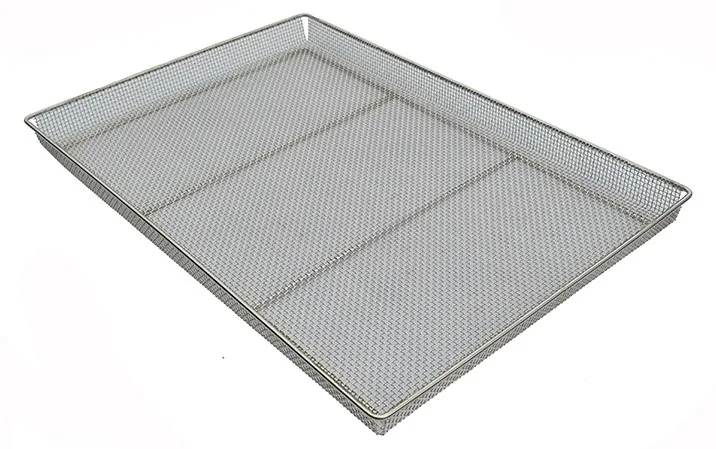
From a manufacturer's perspective, an industrial wire mesh tray is a structural component designed for continuous production environments where hygiene, load stability, and long-term operational reliability are non-negotiable. Unlike consumer-grade racks, industrial trays must withstand repeated washdowns, high-temperature cycling, and mechanical handling without warping, cracking, or shedding wire. The mesh design allows air, heat, and water to pass through freely—making it essential for drying, cooling, baking, and sterilization processes.
Why should your company care? Because the total cost of a cheap tray is never just the unit price. It is the downtime when a weld fails mid-batch, the contamination risk when a coating flakes into food, and the replacement orders that pile up every six months. Strategic buyers source industrial wire mesh trays from manufacturers who understand these risks and engineer accordingly.
Product Features and Engineering Advantages
A well-built industrial wire mesh tray earns its place on the production floor through design details that are easy to overlook in a quotation but impossible to ignore in daily use. Here is what separates a production-grade tray from a lookalike:
- High corrosion resistance – achieved through correct material grade selection and passivation treatment, not just a shiny surface.
- Easy-clean surface – open mesh geometry eliminates liquid pooling and debris traps, supporting HACCP and GMP cleaning protocols.
- Stable load capacity – reinforced frame and cross-bracing distribute weight evenly, preventing sagging under stacked loads.
- Custom manufacturing options – dimensions, mesh opening, wire diameter, and edge treatment tailored to your equipment and process.
The structural design matters more than most buyers realize. A reinforced frame with properly spaced support bars improves load stability during repeated transportation and high-frequency industrial handling. Welded joints—rather than loosely woven intersections—prevent wire displacement and extend service life in vibration-heavy environments. Surface treatment such as electrolytic polishing or passivation enhances cleanability and corrosion resistance, particularly in food-contact and cleanroom applications.
Manufacturing process also determines performance. Automated mesh welding produces consistent weld strength across the entire tray, while manual welding introduces variability that shows up as early failures. Edge finishing—whether hemmed, capped, or ground smooth—protects operators from sharp wire ends and prevents coating damage during handling. These are the details that separate an industrial mesh tray supplier who understands production environments from one who simply bends wire.
Application Scenarios
Industrial wire mesh trays appear across a wide range of sectors, but the reasons for choosing them differ by application. Understanding these use cases helps buyers specify the right tray rather than over- or under-engineering.
Food processing: Trays are used for washing, blanching, cooling, and freezing. Open mesh allows rapid drainage and airflow, reducing batch times and improving hygiene. Stainless steel construction withstands caustic cleaning chemicals and high-pressure washdown.
Bakery and commercial baking: Mesh trays support even heat distribution and prevent bottom burning. They are stacked in rack ovens and must resist thermal cycling without warping.
Industrial manufacturing: Parts washing, degreasing, and coating lines rely on mesh trays to hold components while fluids pass through. Load stability and chemical resistance are critical.
Drying processes: Whether drying produce, herbs, or industrial components, mesh trays maximize air circulation and reduce drying time compared to solid trays.
Pharmaceutical and laboratory: Cleanroom-compatible trays with electropolished surfaces support sterilization and minimize particle retention.
Storage and transportation: Stackable mesh trays improve visibility, ventilation, and space efficiency in warehouses and logistics operations.
In each case, the tray is not simply a container—it is a process enabler. Buyers who specify trays around their actual process conditions get better throughput and fewer headaches.
Material Options and Manufacturing Details
Material selection is where many procurement decisions go wrong. The cheapest option is rarely the lowest total cost. Here is a practical breakdown:
304 stainless steel provides reliable corrosion resistance for food-contact applications and daily industrial cleaning environments. It is the workhorse grade for most food processing and general manufacturing trays. It handles mild acids, alkaline cleaners, and repeated washdown without issue.
316 stainless steel adds molybdenum for superior resistance to chlorides and aggressive chemicals. Choose 316 for seafood processing, pharmaceutical applications, and environments with saline or high-chloride exposure. The cost premium is justified where 304 would pit or corrode prematurely.
201 stainless steel offers a lower-cost alternative with moderate corrosion resistance. It suits dry storage and light-duty applications where moisture and chemicals are limited. Buyers should be cautious about using 201 in wet or food-contact environments.
Aluminum trays are lightweight and suitable for baking and dry applications where corrosion resistance requirements are lower. They are not recommended for caustic washdown or high-humidity environments.
Manufacturing details also affect performance: wire diameter influences load capacity and open area; mesh opening determines airflow and small-part retention; surface treatment (passivation, electropolishing) affects cleanability and corrosion life. A reputable manufacturer will discuss these trade-offs with you rather than simply quoting the lowest price.
Specifications and Technical Parameters
Industrial buyers need concrete specifications to evaluate quotations and ensure equipment compatibility. While exact parameters vary by project, the following ranges reflect common industry practice:
- Size: Custom dimensions based on oven, washer, or rack system requirements; common footprints range from 400×600 mm to 800×1000 mm.
- Wire diameter: Typically 1.5 mm to 5 mm depending on load requirements.
- Mesh opening: 5 mm to 50 mm; smaller openings for small components, larger for airflow-critical drying.
- Load capacity: Static load ratings from 20 kg to 150 kg per tray, depending on design and material.
- Layers: Single-tier or multi-tier stackable configurations.
- Surface treatment: Passivation, electrolytic polishing, or powder coating (for non-food applications).
- Production tolerance: Dimensional tolerances typically ±2 mm on overall dimensions, tighter on critical mounting points.
Available sizes can be customized according to equipment dimensions and production requirements. Buyers should always confirm tray compatibility with existing racks, conveyors, and washing systems before placing bulk orders.
Custom OEM Manufacturing Service
Off-the-shelf trays rarely fit perfectly into an established production line. OEM manufacturing bridges that gap. A capable OEM stainless steel tray manufacturer supports custom size and design, logo marking, special packaging, material selection, prototype development, and bulk production. Prototyping is particularly valuable—it allows buyers to validate fit, load performance, and cleanability before committing to volume.
For custom requirements, please contact our team. Experienced manufacturers will ask about your working environment, load conditions, cleaning regime, and equipment interface before proposing a design. That consultation process is a good indicator of supplier competence.
Purchasing Guide for Industrial Buyers
Effective sourcing comes down to asking the right questions before the purchase order goes out. Consider this checklist:
- Confirm working environment – wet, dry, high-temperature, chemical exposure, or cleanroom?
- Check material requirements – food contact, pharmaceutical, or general industrial?
- Verify equipment compatibility – dimensions, stacking, and handling interface.
- Evaluate supplier production capacity – can they handle your volume and lead time?
- Review quality control – weld inspection, dimensional checks, material certificates.
- Assess export experience and packaging – protection during shipping matters as much as product quality.
- Confirm delivery reliability – ask for references and production schedules.
How to choose size? Start with your existing equipment and process flow, not with a catalog. How to choose material? Match the grade to your cleaning chemicals and environment. How to confirm specifications? Request drawings and, for significant orders, a pre-production sample. How to judge supplier capability? Look beyond price—ask about welding automation, in-house testing, and export documentation. Bulk purchasing works best with a supplier who treats quality control and delivery reliability as part of the contract.
FAQ
Q1: What stainless steel grade is recommended for food processing applications?
304 stainless steel is the standard choice for most food processing environments due to its reliable corrosion resistance and cleanability. For high-chloride or aggressive chemical exposure—such as seafood processing or certain sanitation regimes—316 stainless steel is the safer specification.
Q2: Can the tray size be customized?
Yes. Custom sizes are standard practice for industrial wire mesh trays. Buyers should provide equipment dimensions, load requirements, and any stacking or handling constraints so the manufacturer can design a tray that fits your production line precisely.
Q3: Do you provide OEM manufacturing service?
Yes. OEM service typically includes custom design, material selection, logo marking, special packaging, prototype development, and bulk production. Providing detailed drawings or samples helps streamline the process and ensures the final product meets your specifications.
Q4: What information should buyers provide before quotation?
Provide tray dimensions, material grade, wire diameter and mesh opening requirements, load capacity, operating environment (temperature, chemicals, washdown), surface treatment preferences, order quantity, and delivery timeline. The more detail you share, the more accurate the quotation.
Q5: How do you control product quality?
Quality control should include incoming material verification, weld strength inspection, dimensional checks against drawings, surface treatment evaluation, and final inspection before packaging. Reputable suppliers provide material certificates and inspection reports with shipments.
Q6: What is the typical lead time for bulk orders?
Lead times vary by order size and customization level, typically ranging from 15 to 45 days after drawing approval. Buyers should confirm production schedules in advance and account for shipping time, especially for ocean freight to European or North American markets.
Q7: How should trays be packaged for export?
Export packaging should protect against moisture, impact, and stacking damage. Common practice includes individual wrapping, edge protection, and reinforced pallets or crates. Buyers should specify packaging requirements in the purchase order to avoid transit damage.

