


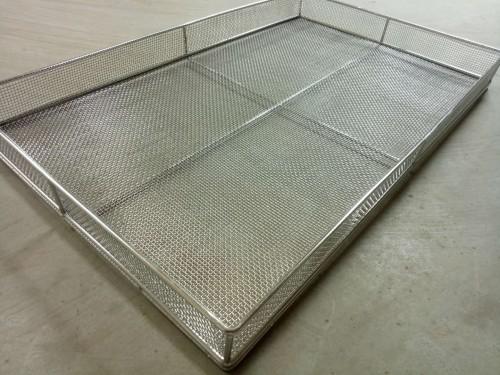
Industrial Wire Mesh Tray Sourcing: A Buyer's Guide to Stainless Steel Solutions
Product Introduction
An industrial wire mesh tray is a robust, open-structured container engineered for continuous production environments where hygiene, load stability, and long-term reliability are non-negotiable. Unlike standard shelving, these trays are designed to withstand repeated handling, high-temperature drying, and rigorous cleaning cycles in sectors ranging from food processing to pharmaceutical manufacturing. For procurement teams, sourcing the correct tray means balancing upfront cost with total cost of ownership—factoring in durability, compatibility with existing racking systems, and compliance with industry standards. This article dissects the critical elements of specifying and purchasing wire mesh trays, drawing on real-world manufacturing expertise to help you avoid common pitfalls and secure a supply chain that supports your production goals.
Product Features and Engineering Advantages
The engineering behind a reliable industrial wire mesh tray extends far beyond a simple welded grid. Key design features directly impact performance and longevity in demanding environments.
- Reinforced frame construction: The perimeter frame is typically formed from heavier-gauge wire or flat bar, welded at stress points to prevent racking and deformation under load. This is essential for trays that undergo frequent forklift or conveyor transitions.
- Precision mesh welding: Consistent spot welding at every intersection ensures the mesh maintains its shape and load distribution capability. Poorly welded joints are the primary failure point in low-quality trays.
- Open structure for airflow and drainage: The mesh design facilitates rapid drying, cooling, and drainage, making it ideal for food processing and industrial washing applications. This also reduces the risk of moisture retention and bacterial growth.
- Surface treatment options: Beyond material selection, surface passivation or electropolishing can further enhance corrosion resistance and cleanability, particularly for pharmaceutical and food-contact applications.
These features translate into tangible benefits: reduced product damage, lower replacement frequency, and improved hygiene compliance. When evaluating suppliers, request detailed engineering drawings and material certificates to verify these construction details.
Application Scenarios
Industrial wire mesh trays are versatile workhorses across multiple sectors. Understanding the specific demands of each application is crucial for correct specification.
- Food Processing: Used for drying, cooling, freezing, and transporting products. Stainless steel construction (typically 304 or 316) ensures compliance with food safety regulations and resistance to daily washdowns.
- Bakery and Commercial Kitchens: Ideal for cooling baked goods, holding ingredients, and oven racking. The open mesh allows even air circulation, preventing sogginess and ensuring consistent product quality.
- Industrial Manufacturing: Employed for parts washing, degreasing, and heat treatment. Trays must withstand chemical exposure and high temperatures without warping.
- Pharmaceutical and Laboratory: Critical for sterilization, drying, and sample storage. Trays require stringent cleaning validation and often use 316L stainless steel for maximum corrosion resistance.
- Storage and Transportation: Used in warehouses and logistics for organizing small parts or components. Stackable designs and compatibility with standard racking systems improve space utilization.
For each scenario, the choice of material, mesh size, and load rating must align with operational realities. For instance, a tray for blast freezing requires different wire diameter and alloy than one used for ambient storage.
Material Options and Manufacturing Details
Material selection is the single most important decision affecting tray lifespan and performance. Here's a breakdown of common options:
- 304 Stainless Steel: The industry standard for food and general industrial use. Offers excellent corrosion resistance in most environments and is easy to clean. Suitable for temperatures up to 870°C.
- 316/316L Stainless Steel: Contains molybdenum for superior resistance to chlorides and aggressive chemicals. Preferred for pharmaceutical, marine, and harsh chemical processing environments. Higher cost but longer life in corrosive conditions.
- 201 Stainless Steel: A lower-cost alternative with reduced nickel content. Adequate for dry or mildly corrosive environments but not recommended for frequent washdowns or food contact.
- Aluminum: Lightweight and corrosion-resistant in atmospheric conditions. Often used in baking and general storage where weight reduction is a priority. Not suitable for high-alkaline or acidic cleaning agents.
Manufacturing details also matter: wire diameter (typically 3mm to 8mm), mesh opening (from 10mm to 50mm), and edge treatment (sheared or rolled) all influence functionality. For custom stainless steel tray requirements, discuss your specific operating environment with the manufacturer to select the optimal alloy and construction.
Specifications and Technical Parameters
Procurement success hinges on precise specifications. While custom sizes are common, the following parameters provide a framework for your RFQ:
- Dimensions: Length and width typically range from 400mm x 600mm to 1200mm x 1500mm, or customized to fit existing racking, ovens, or conveyor systems.
- Wire Diameter: 3mm to 8mm, with heavier gauges for high-load applications.
- Mesh Opening: 10mm x 10mm to 50mm x 50mm, depending on product size and airflow requirements.
- Load Capacity: Static load ratings from 50kg to 500kg, depending on design and material. Always verify with dynamic loading conditions.
- Surface Finish: Mill finish, passivated, or electropolished. Specify Ra values for hygienic applications.
- Manufacturing Tolerance: ±2mm on dimensions is standard; tighter tolerances may be required for automated handling systems.
When requesting quotes, provide operating temperature, chemical exposure, and cleaning method to ensure the supplier recommends suitable materials and construction.
Custom OEM Manufacturing Service
A capable OEM stainless steel tray manufacturer offers more than catalog products. They become an extension of your engineering team. Key custom capabilities include:
- Custom sizing and design: Trays manufactured to your exact drawings or developed collaboratively to optimize functionality.
- Material selection support: Guidance on alloy choice based on your process conditions.
- Prototype development: Pre-production samples for fit, form, and function testing.
- Logo marking and branding: Laser etching or stamping for inventory control or branding.
- Special packaging: Export-ready packaging to prevent damage during transit.
- Bulk production: Scalable manufacturing with consistent quality control.
For custom requirements, please contact our team to discuss your project. Early engagement with a manufacturer's technical staff can prevent costly design errors and ensure the final product meets your operational needs.
Purchasing Guide for Industrial Buyers
Effective procurement of industrial wire mesh trays requires a systematic approach. Consider this checklist:
- Confirm the working environment: Identify temperature range, chemical exposure, and cleaning protocols. This dictates material and surface finish.
- Verify equipment compatibility: Ensure tray dimensions, load ratings, and handling features (e.g., fork entries) match your racking, ovens, and conveyors.
- Check material certifications: Request mill certificates for stainless steel to verify grade and traceability.
- Evaluate supplier production capacity: Assess their ability to meet your volume and lead time requirements. Ask for references from similar industries.
- Review quality control processes: Inquire about weld inspection, dimensional checks, and surface treatment validation.
- Clarify packaging and logistics: Confirm export packaging standards to prevent transit damage, and agree on Incoterms and delivery schedules.
Price should not be the sole criterion. A low-cost tray that fails prematurely can cause production downtime far exceeding the initial savings. Request samples for pilot testing whenever possible.
Frequently Asked Questions (FAQ)
Q1: What stainless steel grade is recommended for food processing applications?
304 stainless steel is the standard for most food processing due to its corrosion resistance and cleanability. For high-chloride environments or more aggressive cleaning chemicals, 316L is preferred. Always confirm compliance with local food safety regulations.
Q2: Can the tray size be customized?
Yes, most manufacturers offer custom sizing to fit specific equipment or racking systems. Provide detailed drawings or dimensions, and discuss load requirements to ensure the design meets your needs.
Q3: Do you provide OEM manufacturing service?
Yes, we support OEM projects including custom designs, material selection, logo marking, and specialized packaging. Our engineering team can collaborate from prototype to bulk production.
Q4: What information should buyers provide before quotation?
Provide tray dimensions, material grade, wire diameter and mesh size, load capacity, operating environment (temperature, chemicals), surface finish requirements, and estimated annual volume. This enables accurate pricing and material recommendations.
Q5: How do you control product quality?
We implement strict quality control at each stage: incoming material inspection, in-process weld and dimension checks, and final surface treatment verification. We can provide inspection reports and material certificates upon request.
Q6: What is the typical lead time for bulk orders?
Lead time varies based on order volume and customization. Standard products may ship in 2-4 weeks; custom orders typically require 4-8 weeks. We will confirm at the time of order.

