


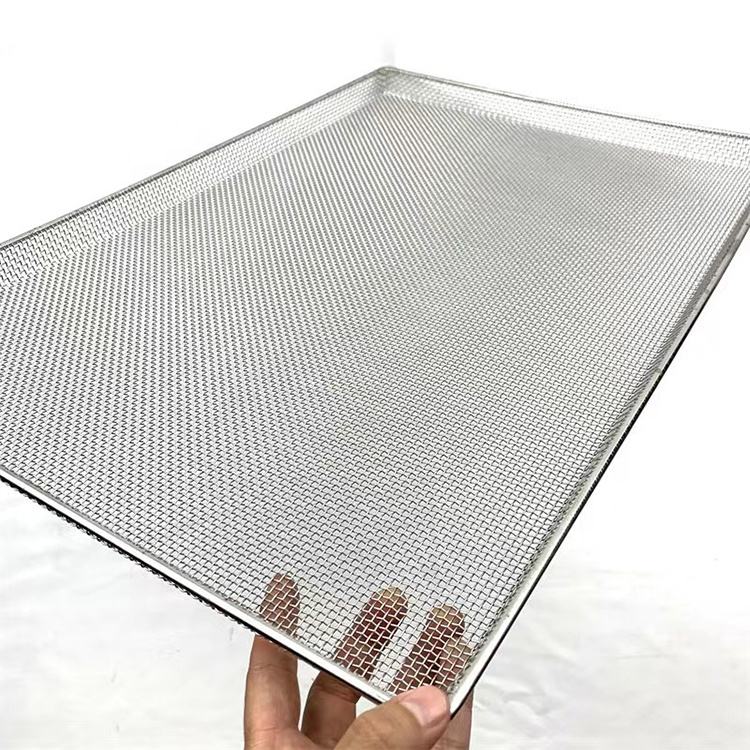
Industrial Food Tray & Stainless Steel Mesh Tray Procurement Guide for B2B Buyers
Product Introduction
In industrial food processing and manufacturing environments, the food tray is not a simple accessory—it is a critical component that directly affects hygiene, workflow efficiency, and product quality. Unlike consumer-grade trays, industrial food trays are engineered for continuous operation, frequent cleaning, and heavy loads. The stainless steel mesh tray in particular has become a standard choice for drying, cooling, and transportation processes where airflow and drainage are essential.
From a manufacturer's perspective, these trays are designed to solve specific production problems: uneven drying due to poor air circulation, contamination risks from non-food-grade materials, and premature failure under repeated handling. For procurement teams, the challenge is not finding a tray—it is finding a supplier who understands the application requirements and can deliver consistent quality at scale. This guide covers the technical and commercial considerations that matter most when sourcing food trays and mesh trays for industrial use.
Product Features and Engineering Advantages
Industrial food trays and stainless steel mesh trays are built around several core engineering principles. The reinforced frame design improves load stability during repeated transportation and high-frequency industrial handling, preventing deformation that would otherwise disrupt automated lines. Mesh openings are precisely controlled to balance airflow, drainage, and product retention—critical in drying and cooling applications.
Manufacturing processes also play a decisive role. Welded joints are ground and polished to eliminate crevices where bacteria can accumulate, meeting food safety standards. Surface treatments such as passivation enhance corrosion resistance and extend service life in wet or chemically aggressive environments. These are not cosmetic features; they are functional requirements that determine whether a tray survives years of daily washdowns or fails within months.
- High corrosion resistance for food contact and cleaning environments
- Easy-cleaning surface with smooth, crevice-free welds
- Stable load capacity under repeated handling and stacking
- Custom manufacturing options for equipment compatibility
- Consistent mesh precision for airflow and drainage control
Application Scenarios
Food processing facilities use stainless steel mesh trays for drying, cooling, blanching, and freezing. The open mesh structure allows uniform air circulation, which is essential for consistent moisture removal and temperature control. In bakery operations, trays support dough proofing and baked goods cooling, where hygiene and load stability are paramount.
Industrial manufacturing and engineering companies use heavy-duty trays for parts washing, degreasing, and heat treatment. The corrosion resistance of stainless steel ensures compatibility with chemical baths and high-temperature processes. Pharmaceutical and laboratory environments require trays that can be sterilized repeatedly without degradation—here, material grade and surface finish are non-negotiable.
Storage and transportation applications benefit from stackable designs that maximize space utilization while protecting products. Commercial production lines rely on trays that interface precisely with automated handling equipment, where dimensional tolerance directly impacts line efficiency. In every scenario, the common thread is that the tray must perform reliably under conditions that would quickly destroy consumer-grade products.
Material Options and Manufacturing Details
Material selection is one of the most consequential decisions in tray procurement. 304 stainless steel provides reliable corrosion resistance for food contact applications and daily industrial cleaning environments, making it the default choice for most food processing operations. 316 stainless steel offers superior resistance to chlorides and aggressive chemicals, suitable for pharmaceutical, marine, and heavy chemical exposure. 201 stainless steel is a cost-effective option for dry environments and lighter-duty applications where corrosion exposure is limited.
Aluminum trays are lightweight and offer good thermal conductivity, making them suitable for baking and cooling applications where weight reduction matters. However, aluminum is less resistant to alkaline cleaning agents and is generally not recommended for harsh washdown environments. The cost difference between grades is significant—201 is the most economical, 304 sits in the mid-range, and 316 commands a premium—but the right choice depends on the actual working environment, not on selecting the most expensive option by default.
Specifications and Technical Parameters
Procurement teams should confirm a range of technical parameters before placing orders. Available sizes can be customized according to equipment dimensions and production requirements, but standard ranges help with budgeting and lead time planning. Typical mesh trays range from 300mm to 1200mm in length, with wire diameters between 1.0mm and 3.0mm and mesh openings from 5mm to 50mm depending on the application.
Load capacity depends on frame design, wire diameter, and support structure—industrial trays commonly handle loads from 20kg to 100kg or more. Surface treatments include passivation, electropolishing, and pickling, each suited to different hygiene or corrosion requirements. Production tolerances for dimensions and flatness should be agreed upon in writing, especially for trays that interface with automated equipment. Where specific parameters are not standardized, buyers should provide drawings or samples to ensure compatibility.
Custom OEM Manufacturing Service
For buyers with specific equipment interfaces or branding requirements, OEM manufacturing is often the most practical route. Custom size and design services allow trays to fit existing racks, conveyors, and washing systems without modification. Logo marking, special packaging, and material selection can be incorporated into production runs. Prototype development is available for new applications, allowing buyers to validate fit and performance before committing to bulk orders.
Bulk production capabilities should be verified through factory audits or sample orders. Production capacity, quality control processes, and export experience are key indicators of a supplier's ability to deliver consistently. For custom requirements, please contact our team to discuss specifications, volumes, and timelines.
Purchasing Guide for Industrial Buyers
Effective procurement starts with a clear specification. Begin by confirming the working environment—temperature, moisture, chemicals, and cleaning methods—as this determines material grade. Verify equipment compatibility by checking dimensions, load points, and handling interfaces. Evaluate supplier production capacity through references, factory audits, or trial orders, and confirm quality control procedures for welds, dimensions, and surface finish.
- Confirm working environment including chemicals and cleaning methods
- Check material requirements against food safety and corrosion needs
- Verify equipment compatibility with drawings or samples
- Evaluate supplier production capacity and quality control systems
- Agree on packaging and delivery terms before bulk production
Batch procurement should also address packaging suitable for sea freight, delivery reliability, and documentation for customs clearance. A supplier with export experience will anticipate these requirements and reduce delays.
FAQ
What stainless steel grade is recommended for food processing applications?
304 stainless steel is the standard recommendation for most food processing applications due to its reliable corrosion resistance and compliance with food contact requirements. For environments with chlorides or aggressive cleaning chemicals, 316 stainless steel is preferred despite the higher cost.
Can the tray size be customized?
Yes, tray dimensions can be customized to match equipment interfaces, rack systems, and production line requirements. Buyers should provide drawings or physical samples to ensure accurate fit and avoid costly modifications after delivery.
Do you provide OEM manufacturing service?
OEM manufacturing is available, including custom design, logo marking, special packaging, and material selection. Prototype development can be arranged for new applications, and bulk production follows agreed specifications and quality standards.
What information should buyers provide before quotation?
Buyers should provide dimensions, material grade, load requirements, mesh specifications, surface treatment, quantity, and delivery destination. Application details such as cleaning methods and operating temperature help suppliers recommend the most suitable configuration.
How do you control product quality?
Quality control covers incoming material inspection, dimensional checks during production, weld quality verification, surface finish inspection, and final pre-shipment inspection. Buyers can request inspection reports and arrange third-party inspections for bulk orders.

