


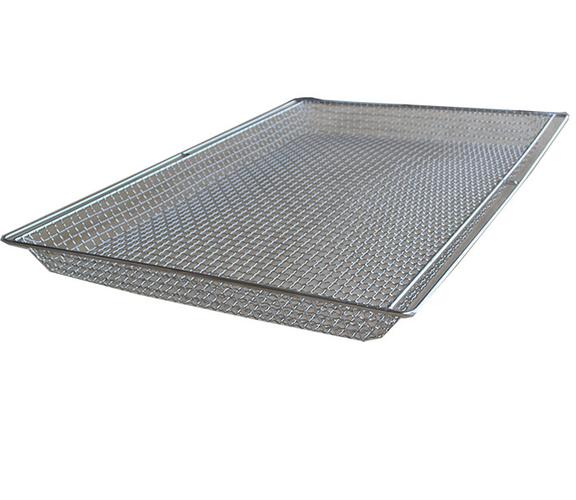
Food Industrial Tray Sourcing: A Buyer’s Guide to Stainless Steel Mesh and Solid Trays for Food Processing
Product Introduction
In food processing plants, bakeries, and industrial kitchens, the food industrial tray is not a commodity—it is a production asset. These trays carry raw ingredients, intermediate products, and finished goods through washing, drying, baking, cooling, freezing, and transport. When a tray fails, the line stops. When a tray is hard to clean, hygiene audits suffer. When dimensions are off by a few millimeters, automated handling equipment jams. That is why buyers in Europe and North America treat tray sourcing as an engineering decision, not a price-only purchase.
This article is written for importers, distributors, wholesalers, industrial buyers, engineering companies, food processing companies, and manufacturing companies who need a reliable food industrial tray supply partner. It covers product design, material selection, customization, quality control, and practical purchasing steps. Whether you need a stainless steel drying tray for an oven line or a heavy-duty mesh tray for a blast freezer, the same sourcing discipline applies: define the working environment, verify material grade, confirm equipment compatibility, and evaluate the manufacturer’s production and export capability.
Product Features and Engineering Advantages
A well-built industrial tray is designed for continuous production environments where hygiene, load stability, and long-term operation reliability are critical. The difference between a tray that lasts three months and one that lasts three years usually comes down to three things: structural design, manufacturing process, and material consistency.
Structural design. Reinforced frame designs improve load stability during repeated transportation and high-frequency industrial handling. Cross-bracing or double-welded corners prevent racking when trays are stacked or moved on conveyors. For mesh trays, wire spacing and wire diameter are engineered to support the product weight without sagging, while still allowing airflow and drainage.
Manufacturing process. Automated wire forming, robotic welding, and uniform surface treatment reduce weak points. Pickling and passivation after welding remove heat tint and restore corrosion resistance—an important detail for food contact surfaces that are cleaned daily with detergents and sanitizers.
Industrial environment adaptability. Trays must tolerate repeated wash cycles, temperature swings from -40°C to over 250°C in some baking or freezing applications, and contact with fats, acids, and cleaning chemicals. A properly engineered tray maintains its shape and surface finish under these conditions, reducing replacement frequency and downtime.
Key product features buyers typically request include:
- High corrosion resistance for wet and food-contact environments
- Easy-to-clean surfaces with smooth welds and no traps for residue
- Stable load capacity under stacked or conveyor handling
- Custom manufacturing options for non-standard equipment
- Compatibility with automated washing, drying, and freezing lines
Application Scenarios
The food industrial tray appears across many production stages. In food processing, mesh and solid trays carry vegetables, meat, and seafood through washing, blanching, and draining. In bakery operations, they hold dough, bread, and pastries during proofing, baking, and cooling. In industrial manufacturing, similar tray designs are used for parts washing, coating, and drying—so buyers often source from the same manufacturer for both food and non-food lines.
In drying processes, a stainless steel drying tray with controlled mesh openings allows uniform airflow and moisture removal. In cleaning processes, trays must drain quickly and resist chemical cleaners. For storage and transportation, stackable trays improve space utilization in cold rooms and shipping containers. In pharmaceutical and laboratory settings, trays are used for glassware drying, sample handling, and cleanroom transfer, where surface finish and cleanliness are paramount. In commercial production, such as central kitchens and catering facilities, trays support high-volume prep and distribution.
Each application drives different specifications. A blast freezer tray needs low-temperature toughness and stable dimensions. A baking tray needs heat resistance and even airflow. A washing tray needs open mesh and reinforced edges. Buyers should always describe the full process—temperature, chemicals, load, handling method—before requesting a quotation.
Material Options and Manufacturing Details
Material choice directly affects service life, hygiene compliance, and total cost. The most common options are 304 stainless steel, 316 stainless steel, 201 stainless steel, and aluminum.
304 stainless steel provides reliable corrosion resistance for food contact applications and daily industrial cleaning environments. It is the standard choice for most food processing trays and offers a good balance of cost and performance. 316 stainless steel adds molybdenum for superior resistance to chlorides and harsh chemicals, making it suitable for seafood processing, saline environments, and pharmaceutical applications where cleaning agents are aggressive. 201 stainless steel is a lower-cost option with lower nickel content; it may suit dry or light-duty applications but is not recommended for prolonged wet or acidic exposure. Aluminum is lightweight and conducts heat well, making it common in baking, but it requires careful cleaning and is less resistant to strong alkaline detergents.
Manufacturing details matter as much as the base metal. Look for uniform wire diameter, consistent mesh opening, fully welded joints, and post-weld passivation. Surface treatment options include polished, sandblasted, or passivated finishes, depending on hygiene requirements and appearance expectations.
Specifications and Technical Parameters
Industrial buyers should confirm a full specification sheet before ordering. Typical parameters include size (length × width × height), wire diameter, mesh opening, thickness of frame material, load capacity, number of layers or stackability, surface treatment, and production tolerance. Available sizes can be customized according to equipment dimensions and production requirements. For standard ranges, many manufacturers offer trays from 300 mm to 1200 mm in length, with wire diameters from 1.5 mm to 6 mm and mesh openings from 5 mm to 50 mm, depending on the application.
Load capacity should be stated under defined support conditions—for example, uniformly distributed load on a rack versus point loading on a conveyor. Tolerance matters for automated lines; specify acceptable dimensional deviation, usually ±1–2 mm for critical interfaces. Surface treatment and weld quality should be described in the purchase order to avoid disputes.
Custom OEM Manufacturing Service
For non-standard equipment or proprietary processes, OEM manufacturing is often the most practical route. A capable factory can support custom size, custom design, logo marking, special packaging, material selection, prototype development, and bulk production. Prototypes allow buyers to test fit, load, and cleaning performance before committing to volume. During bulk production, request in-process inspection reports and pre-shipment photos. For custom requirements, please contact our team to discuss drawings, samples, and target volumes.
Purchasing Guide for Industrial Buyers
Before requesting quotations, gather the following information: working environment (temperature, humidity, chemicals), load per tray, handling method, equipment interface dimensions, and hygiene standards. Then follow this checklist:
- Confirm working environment and cleaning regime
- Check material requirements and certification needs
- Verify equipment compatibility, including rack and conveyor dimensions
- Evaluate supplier production capacity and quality control process
- Review export experience, packaging, and delivery reliability
When comparing suppliers, ask for samples, factory audit reports, and references from similar markets. A supplier with strong export experience will understand packaging requirements for long-sea transit and provide clear documentation. Delivery reliability is often more valuable than a marginally lower unit price.
FAQ
What stainless steel grade is recommended for food processing applications?
304 stainless steel is the standard for most food contact trays due to its corrosion resistance and cleanability. For seafood, saline, or aggressive chemical environments, 316 stainless steel is preferred. 201 is only suitable for dry or light-duty use. Always confirm the grade with mill certificates and verify surface finish after welding.
Can the tray size be customized?
Yes. Most manufacturers offer custom sizes based on equipment dimensions, load requirements, and handling methods. Provide drawings or samples, and confirm tolerances for critical interfaces. Prototyping is recommended before bulk production to avoid costly rework.
Do you provide OEM manufacturing service?
Yes. OEM services typically include custom design, material selection, logo marking, special packaging, and private labeling. Buyers should discuss intellectual property, tooling costs, and minimum order quantities upfront. A clear specification document and approval sample help prevent misunderstandings.
What information should buyers provide before quotation?
Provide the working environment, load capacity, dimensions, material grade, surface treatment, quantity, and delivery target. Photos or drawings of the equipment interface are helpful. The more detail you provide, the more accurate the quotation and the lower the risk of specification mismatch.
How do you control product quality?
Quality control should cover incoming material inspection, in-process welding and dimension checks, surface treatment verification, and pre-shipment inspection. Ask for inspection reports, material certificates, and photos. For repeated orders, establish a golden sample and a written quality agreement.
What is the typical lead time for bulk orders?
Lead time depends on customization, quantity, and material availability. Standard trays may ship in 15–25 days, while custom OEM orders often require 30–45 days including sampling. Confirm production schedules and shipping terms in the contract, and allow buffer time for ocean freight.
How should trays be packaged for export?
Packaging should prevent deformation and surface damage during transport. Common methods include individual wrapping, edge protection, and reinforced cartons or pallets. For large orders, request photos of the packaging process and ensure labeling meets your warehouse requirements.
Image ALT Text Suggestion
Stainless steel mesh food industrial tray for drying applications – manufacturer
SEO Title
Food Industrial Tray Sourcing Guide for B2B Buyers
Meta Description
Source food industrial trays with confidence. Learn material grades, specifications, OEM options, and supplier vetting for stainless steel mesh and solid trays.
SEO Keywords
food industrial tray, stainless steel mesh tray, industrial mesh tray supplier, food processing tray, commercial drying rack, custom stainless steel tray, OEM stainless steel tray manufacturer, stainless steel drying tray

