


Dehydrator Tray Procurement: A Comprehensive Guide for Industrial Buyers
Product Introduction
For industrial buyers, importers, and food processing companies, the dehydrator tray is far more than a simple accessory—it is a fundamental element in continuous production environments where hygiene, load stability, and long-term operational reliability are paramount. These trays serve as the primary contact surface for products during drying, cooling, freezing, or storage processes. Whether used in large-scale dehydration systems, blast freezers, or industrial ovens, the tray must withstand repeated thermal cycling, mechanical handling, and rigorous sanitation protocols.
From a manufacturing perspective, a well-engineered dehydrator tray solves several critical production challenges: it ensures uniform airflow for consistent drying, prevents product contamination, and supports efficient material handling. For procurement teams, sourcing the correct tray means balancing initial cost with total cost of ownership—considering durability, maintenance, and compatibility with existing equipment. This article will guide you through the technical and commercial aspects of purchasing dehydrator trays, with a focus on stainless steel mesh tray solutions that dominate high-demand industries.
Product Features and Engineering Advantages
Industrial dehydrator trays are designed with features that directly address the rigors of continuous operation. Key engineering advantages include:
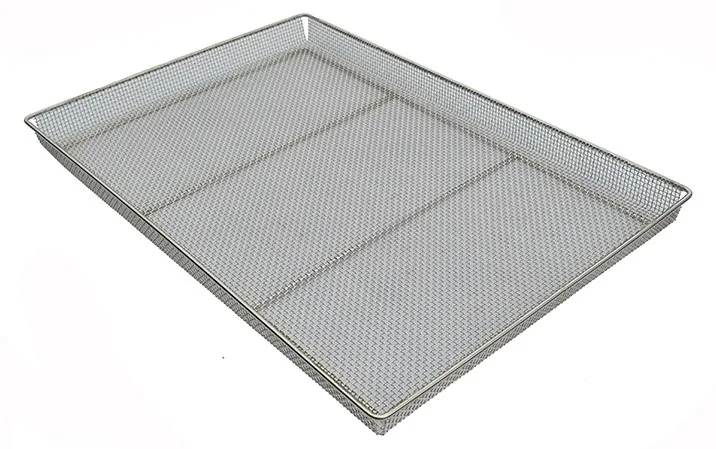
- Reinforced frame construction: The frame is typically formed from a heavier gauge wire or flat bar, then welded at stress points to improve load stability during repeated transportation and high-frequency industrial handling. This prevents deformation under heavy product loads.
- Precision mesh welding: The mesh is resistance-welded to the frame, ensuring consistent openings that allow optimal airflow while containing small products. This is crucial for uniform drying and preventing product loss.
- Corrosion-resistant surface: Electropolished or passivated finishes enhance corrosion resistance and facilitate easy cleaning, meeting strict food safety standards.
- Stackability and compatibility: Trays are designed with integrated stacking lugs or edge profiles to securely nest, saving space during storage and ensuring stable stacking in rack systems.
- High-temperature tolerance: Depending on material selection, trays can withstand temperatures from -40°C to over 300°C, suitable for drying, baking, and freezing applications.
These features translate into tangible benefits: reduced product damage, longer service life, lower replacement frequency, and minimized downtime. For engineering companies and OEMs, the trays can be customized to integrate seamlessly with existing conveyor systems, racking, or automated handling equipment.
Application Scenarios
Dehydrator trays are versatile and find critical use across numerous industries:
- Food Processing: Used for drying fruits, vegetables, meats, and seafood. Stainless steel mesh trays provide excellent airflow and are easy to sanitize, preventing bacterial growth.
- Bakery: Ideal for proofing, baking, and cooling bread, pastries, and confectionery. The open mesh design allows even heat distribution and rapid cooling.
- Industrial Manufacturing: Employed for parts drying, coating, and degreasing. Trays withstand chemical exposure and mechanical stress.
- Pharmaceutical: Essential for drying granules, tablets, and powders in cleanroom environments. Trays are manufactured to cGMP standards with electropolished surfaces.
- Laboratory: Used for sample drying, sterilization, and storage. Small-scale trays with precise mesh openings ensure sample integrity.
In each scenario, the choice of tray is driven by the need for hygiene, durability, and compatibility with process equipment. For instance, a food processing plant might require 304 stainless steel trays with a specific mesh size to prevent product from falling through, while a pharmaceutical manufacturer might demand 316L stainless steel with a mirror finish for cleanability.
Material Options and Manufacturing Details
Material selection is a critical decision that impacts performance, lifespan, and cost. Our trays are available in several grades:
- 304 Stainless Steel: Offers reliable corrosion resistance for food contact applications and daily industrial cleaning environments. Suitable for most food processing and general manufacturing.
- 316 Stainless Steel: Contains molybdenum for enhanced resistance to chlorides and harsh chemicals. Ideal for pharmaceutical, marine, and chemical processing applications where superior corrosion resistance is required.
- 201 Stainless Steel: A cost-effective alternative with moderate corrosion resistance, suitable for dry environments and light-duty applications.
- Aluminum: Lightweight and good thermal conductivity, often used in baking and cooling where weight is a concern. However, it is less durable in aggressive chemical environments.
Manufacturing details include wire diameter selection (typically 1.5mm to 4mm), mesh opening (from 2mm to 50mm), and frame thickness. We also offer surface treatments such as electropolishing, passivation, and coating to enhance performance. Each tray is engineered to meet specific load-bearing requirements and is tested for weld strength and flatness.
Specifications and Technical Parameters
When specifying dehydrator trays, buyers should consider the following parameters:
- Dimensions: Custom sizes are available to fit existing rack systems, ovens, or conveyor lines. Common sizes range from 400x600mm to 800x1000mm.
- Wire Diameter and Mesh Opening: Determined by product size and airflow requirements. For example, a 2mm wire with a 10mm opening is common for small vegetables.
- Load Capacity: Typically designed to support 10-50 kg per tray, depending on frame design.
- Number of Layers: Trays can be stacked up to 20 layers high in rack systems.
- Surface Treatment: Electropolished, passivated, or as-welded finishes.
- Production Tolerance: Dimensional tolerances are maintained within ±1mm to ensure compatibility.
For custom requirements, buyers should provide detailed drawings or samples. Our engineering team can assist in optimizing designs for manufacturability and cost.
Custom OEM Manufacturing Service
As an experienced OEM manufacturer, we offer comprehensive customization services to meet specific procurement needs. Our capabilities include:
- Custom size and design: From simple rectangular trays to complex shapes with reinforcing ribs or handles.
- Material selection: Assistance in choosing the optimal grade based on application and budget.
- Logo marking: Laser etching or stamping for brand identification.
- Special packaging: Export-ready packaging with corrosion protection and custom labeling.
- Prototype development: Rapid prototyping to validate design before mass production.
- Bulk production: High-volume manufacturing with consistent quality control.
For custom requirements, please contact our team to discuss your project. We provide engineering support and competitive quotations.
Purchasing Guide for Industrial Buyers
To ensure a successful procurement process, consider the following checklist:
- Confirm working environment: Identify temperature range, humidity, and chemical exposure to select appropriate material.
- Check material requirements: Verify food safety certifications (e.g., FDA, LFGB) and cleanroom compatibility if needed.
- Verify equipment compatibility: Ensure tray dimensions, stacking features, and load capacity match existing racks and conveyors.
- Evaluate supplier production capacity: Assess manufacturing capabilities, quality control processes, and lead times.
- Review samples and certifications: Request pre-production samples and material certificates.
- Clarify packaging and logistics: Confirm export packaging, shipping terms, and delivery reliability.
- Consider total cost of ownership: Balance initial price with durability and maintenance costs.
When evaluating suppliers, look for experience in export markets, a track record of quality consistency, and responsive communication. A reliable partner will provide technical support and transparent documentation.
Frequently Asked Questions (FAQ)
Q1: What stainless steel grade is recommended for food processing applications?
A1: 304 stainless steel is commonly used for food processing due to its good corrosion resistance and cost-effectiveness. For applications involving high salt or acidic products, 316 stainless steel is recommended for enhanced corrosion resistance. Both grades meet food safety requirements when properly finished and maintained.
Q2: Can the tray size be customized?
A2: Yes, we offer custom sizes to fit your equipment. Please provide dimensions, load requirements, and any specific features. Our engineering team will design a tray that meets your exact specifications, with production tolerances typically within ±1mm.
Q3: Do you provide OEM manufacturing service?
A3: Absolutely. We offer full OEM services including custom design, logo marking, special packaging, and material selection. Our team can develop prototypes and scale to bulk production with consistent quality control. Contact us to discuss your OEM requirements.
Q4: What information should buyers provide before quotation?
A4: To provide an accurate quote, please provide: tray dimensions (length, width, height), wire diameter and mesh opening, material grade, quantity, surface treatment requirements, and any special features (e.g., handles, stacking lugs). Drawings or samples are helpful but not mandatory.
Q5: How do you control product quality?
A5: We implement a rigorous quality control system: incoming material inspection, in-process checks during wire drawing, welding, and finishing, and final inspection for dimensions, weld strength, and surface condition. We can provide material certificates and inspection reports upon request.
Q6: What is the typical lead time for bulk orders?
A6: Lead time depends on order quantity and customization complexity. For standard trays, production typically takes 4-6 weeks after order confirmation. Custom designs may require 6-8 weeks. We will provide a detailed schedule upon quotation.
Q7: How are the trays packaged for export?
A7: Trays are typically packed in wooden crates or cartons with protective interleaving to prevent scratches. We can customize packaging to suit your requirements, including labeling and moisture protection. We ensure compliance with international shipping standards.
Conclusion
Sourcing dehydrator trays for industrial applications requires careful consideration of material, design, and supplier capability. By following the guidelines in this article, procurement professionals can make informed decisions that enhance operational efficiency and reduce long-term costs. For further assistance or to request a quotation, please contact our team today.
This article is intended for B2B procurement professionals. Product specifications and availability are subject to change. Please consult with our sales team for the most current information.

