


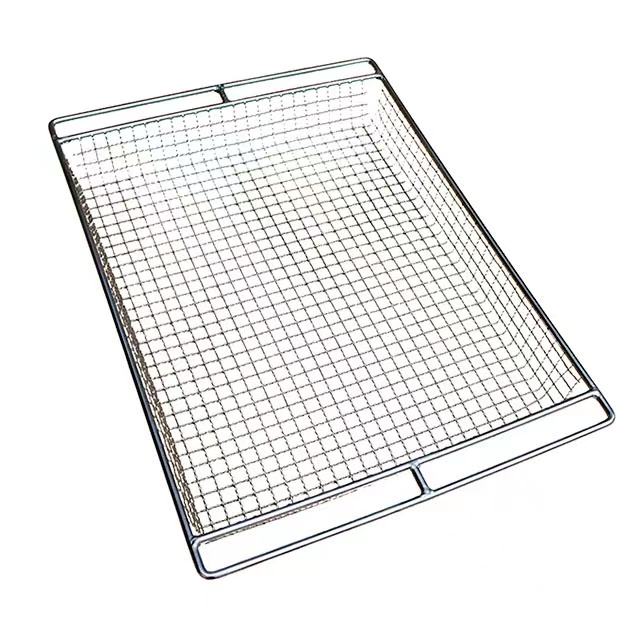
Cooling Rack Drying Tray: A Strategic Sourcing Guide for Industrial Buyers
Product Introduction
In the world of industrial food processing and manufacturing, the cooling rack drying tray is a fundamental component that often goes unnoticed until it fails. As a procurement professional, you understand that every piece of equipment on the production floor must justify its cost through reliability, hygiene, and throughput. This industrial tray is specifically engineered for continuous production environments where hygiene, load stability, and long-term operation reliability are non-negotiable.
Unlike consumer-grade products, a cooling rack drying tray used in a commercial setting must withstand high-frequency handling, aggressive cleaning agents, and thermal fluctuations. It serves as the critical interface between processing stages—whether it's transferring baked goods from the oven to the cooling tunnel, holding pharmaceutical ingredients during drying, or supporting components through a wash cycle. When these trays fail, the ripple effects are immediate: product loss, production downtime, and compromised safety standards. Therefore, selecting a manufacturer with deep expertise in industrial fabrication is not just a purchasing decision; it's a risk management strategy.
Product Features and Engineering Advantages
When evaluating a cooling rack drying tray, it's essential to look beyond the surface. The engineering behind the product dictates its performance in your specific environment. Our trays are designed with a reinforced frame structure that enhances load stability during repeated transportation and high-frequency industrial handling. This is not a generic 'durable' claim; it's a direct result of finite element analysis and real-world stress testing. The corners are often the weakest point, so we employ double-welded joints or seamless bending techniques to eliminate failure points.
The manufacturing process also plays a pivotal role. We utilize precision laser cutting for mesh openings, ensuring consistent airflow and drainage—critical for even cooling and drying. The surface treatment, whether it's passivation for stainless steel or anodizing for aluminum, is conducted in-house to maintain strict quality control. This results in a tray that not only resists corrosion but also reduces product adhesion, making cleaning faster and more thorough, which is a key consideration for HACCP-compliant facilities.
Key engineering advantages include:
- High corrosion resistance due to optimal material selection and surface treatment, extending service life in wet or humid environments.
- Easy cleaning surface with smooth welds and non-porous finishes, reducing sanitation time and risk of bacterial growth.
- Stable load capacity with reinforced frames and calculated mesh support, preventing sagging under heavy loads.
- Custom manufacturing options to fit specific equipment dimensions, ensuring seamless integration into existing lines.
Application Scenarios
The versatility of a well-designed cooling rack drying tray is best understood through its applications. In food processing, these trays are indispensable for cooling baked goods, confectionery, and prepared meals. They allow for rapid air circulation around the product, reducing cooling time and preventing condensation buildup that can lead to sogginess or spoilage. In industrial manufacturing, they are used for drying and cooling metal parts after coating or heat treatment, where uniform airflow is essential for consistent finish quality.
In pharmaceutical and laboratory settings, stainless steel drying trays are often required for their non-reactive properties and ability to withstand sterilization cycles. They are used in drying ovens and cleanrooms, where particle shedding must be minimized. The bakery industry relies on these trays for proofing, baking, and cooling, often with custom mesh sizes to accommodate delicate pastries. Commercial production facilities, such as those producing pet food or snacks, use them for continuous conveyor systems, where tray compatibility and weight consistency are critical for smooth operation.
Each application demands specific features: food processing might require 304 stainless steel for corrosion resistance, while pharmaceutical applications may demand 316 for enhanced chemical resistance. Understanding these nuances is key to selecting the right tray.
Material Options and Manufacturing Details
Material choice is a primary driver of both performance and cost. For industrial cooling rack drying trays, the most common materials are stainless steel grades 304, 316, and 201, as well as aluminum. 304 stainless steel provides reliable corrosion resistance for food contact applications and daily industrial cleaning environments. It is the workhorse material, offering a balance of durability and affordability. 316 stainless steel includes molybdenum, which significantly improves resistance to chlorides and acids, making it suitable for pharmaceutical, chemical, and marine environments where harsh cleaning agents are used.
201 stainless steel is a lower-cost alternative with reduced nickel content, offering moderate corrosion resistance for dry or less demanding environments. It is often used in budget-sensitive applications where exposure to moisture is limited. Aluminum trays are lightweight and offer excellent thermal conductivity, making them ideal for cooling applications where weight reduction is crucial. However, they require surface treatments like anodizing to resist corrosion and are not suitable for highly acidic or alkaline environments.
Our manufacturing process includes controlled atmosphere brazing for aluminum and TIG welding for stainless steel, ensuring strong, clean joints. We also offer custom mesh configurations, frame reinforcements, and stacking features to optimize space utilization.
Specifications and Technical Parameters
When specifying a cooling rack drying tray, procurement teams should consider a range of parameters to ensure compatibility and performance. While standard sizes exist, most industrial applications require customization. Available sizes can be customized according to equipment dimensions and production requirements, with typical lengths ranging from 400mm to 1200mm and widths from 300mm to 800mm.
Key specifications to define include:
- Size: Overall dimensions and corner radii to fit racks, ovens, or conveyors.
- Thickness: Material gauge (e.g., 0.8mm to 2.0mm) affecting load capacity and durability.
- Capacity: Maximum weight load, often 10kg to 50kg per tray depending on design.
- Layers: Number of tiers if used in a rack system.
- Mesh opening: Aperture size (e.g., 5mm to 20mm) to balance airflow and product support.
- Wire diameter: Thickness of mesh wires (e.g., 1.0mm to 3.0mm) for strength.
- Tray compatibility: Ensure trays fit existing racks, trolleys, or conveyor systems.
- Surface treatment: Passivation, electropolishing, or anodizing to enhance corrosion resistance.
- Production tolerance: Dimensional accuracy, typically ±1mm for critical fits.
Providing detailed drawings or samples to the manufacturer is the best way to ensure a precise fit.
Custom OEM Manufacturing Service
For many industrial buyers, off-the-shelf trays simply don't meet the specific needs of their production line. That's where our OEM manufacturing service comes in. We work closely with your engineering team to develop custom solutions from concept to production. Our capabilities include custom size and design, where we can modify mesh patterns, frame structures, and stacking features. We also offer logo marking for brand identification, special packaging for export or automated feeding systems, and material selection guidance based on your operating environment.
Prototype development is a key part of our service; we can produce functional prototypes for testing before committing to bulk production. Our engineering team uses CAD software to create detailed drawings and can provide 3D models for approval. For custom requirements, please contact our team to discuss your project. We handle projects from small batches to high-volume production, ensuring consistent quality and timely delivery.
Purchasing Guide for Industrial Buyers
As a procurement professional, you need to make informed decisions that balance cost, quality, and risk. Here are practical guidelines for sourcing cooling rack drying trays. First, clearly define your working environment: is it wet, dry, acidic, or subject to high temperatures? This determines the material grade. Second, check material requirements against industry standards (e.g., FDA, EU 1935/2004 for food contact). Third, verify equipment compatibility by providing exact dimensions and tolerances to the supplier. Fourth, evaluate supplier production capacity—can they handle your order volume and lead time? Look for certifications like ISO 9001 and ask for references.
Before placing a bulk order, consider these procurement checkpoints:
- Confirm working environment: Ensure the material and finish are suitable for your cleaning chemicals and temperature range.
- Check material requirements: Request mill certificates or test reports for material composition.
- Verify equipment compatibility: Ask for sample trays or 3D models to test fit.
- Evaluate supplier production capacity: Schedule a factory audit or request video walkthrough.
- Review quality control processes: Understand their inspection procedures and defect handling.
- Clarify packaging and logistics: Ensure trays are protected during transit to avoid deformation.
Finally, always request a pre-production sample to validate quality before mass production. A reliable supplier will welcome this step.
FAQ
Q1: What stainless steel grade is recommended for food processing applications?
For most food processing applications, 304 stainless steel is the standard choice due to its excellent corrosion resistance and compliance with food safety regulations. However, if your facility uses chlorinated cleaners or processes acidic foods, 316 stainless steel offers superior protection against pitting and corrosion. We recommend evaluating your cleaning protocols and product pH to make the final decision.
Q2: Can the tray size be customized?
Absolutely. We manufacture trays to your exact specifications. Simply provide drawings, samples, or detailed dimensions including length, width, height, mesh pattern, and any special features. Our engineering team will review and propose a solution that fits your equipment and production needs.
Q3: Do you provide OEM manufacturing service?
Yes, we offer full OEM services including custom design, logo marking, special packaging, and private labeling. Our team can work from your concepts or develop new designs based on your functional requirements. We handle everything from prototyping to bulk production.
Q4: What information should buyers provide before quotation?
To provide an accurate quote, we need: tray dimensions (with tolerances), material grade, mesh specifications, surface treatment, quantity, and any special requirements like stacking or branding. If you have drawings or samples, that's even better. We'll also ask about your delivery timeline and destination port.
Q5: How do you control product quality?
We implement a rigorous quality control system from incoming materials to final inspection. This includes material certification, in-process checks during cutting, welding, and finishing, and final dimensional and visual inspections. We can provide inspection reports and support third-party inspections upon request.
Q6: What is the typical lead time for bulk orders?
Lead time varies based on order volume and customization complexity. For standard trays, it's usually 15-20 days after sample approval. Custom orders may take 25-35 days. We'll provide a detailed production schedule upon order confirmation and keep you updated on progress.
Q7: Can you provide samples for testing?
Yes, we can provide samples for evaluation. For standard items, samples may be free, but the buyer covers shipping costs. For customized samples, a sample fee applies, which is refundable upon bulk order confirmation. We recommend testing samples in your actual production environment.

